
The New York Knicks are NBA Champions.
My earliest memories in life are of Bernard King lighting up the Detroit Pistons in 1984 wearing iconic blue and orange. I remember where I was in 1993 when the Knicks went up 2-0 against Michael Jordan’s championship Chicago Bulls – the only team to hold that kind of lead against that team. (It was Ronnie Totten’s couch in White Sulphur Springs.) I remember where I was when Jordan and company came roaring back for the late sweep, breaking my young heart for the first of many times. (John Earle’s living room.)
I remember screaming at my television during the 1994 NBA Finals against the Rockets when NBC left Game 5 to go to live coverage of OJ Simpson in his white Bronco. It’s been decades – DECADES – of suffering, and Saturday night was a cathartic moment for us Knicks fans.
Inspiration Strikes
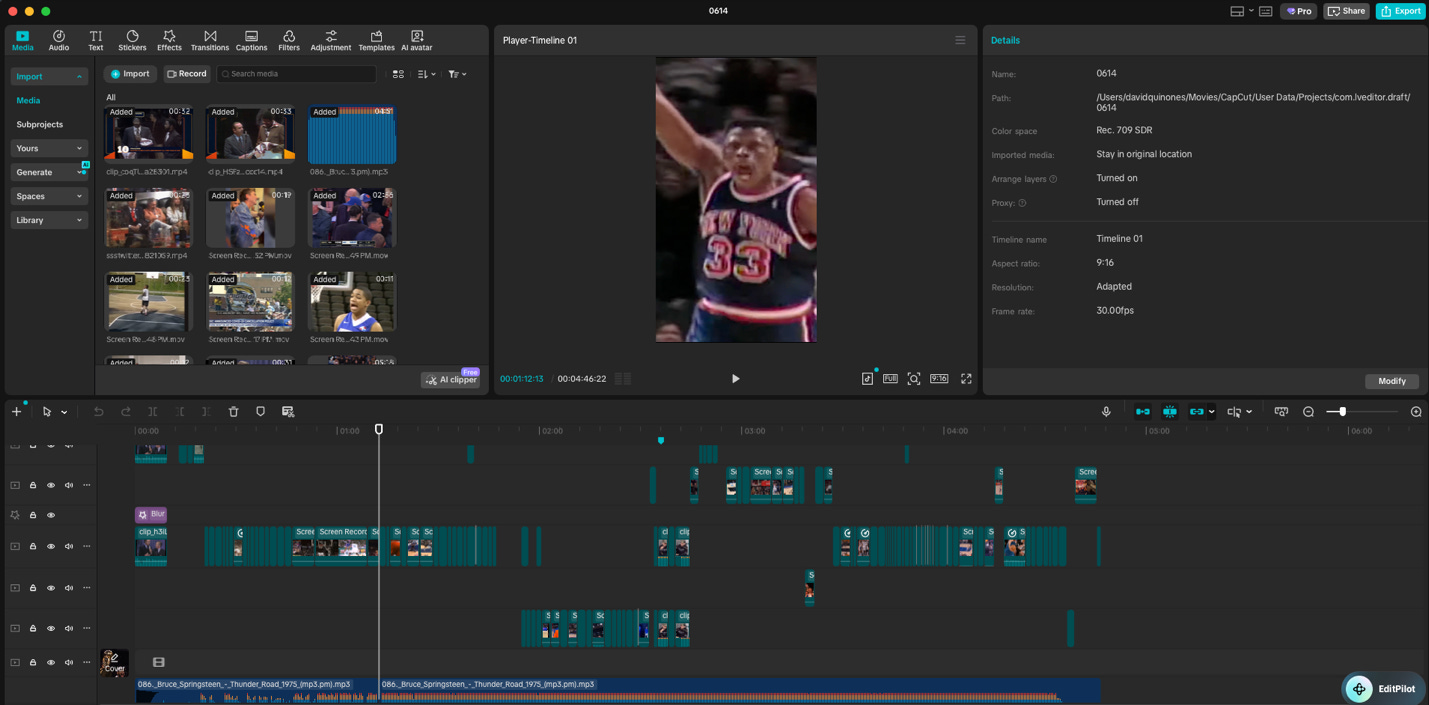
I was inspired to make a video, ahem, an “edit”, about it. I had the idea of laying a timeline of Knicks history over Bruce Springsteen’s Thunder Road, an important song to me that also evokes formative memories of sitting in my dad’s Monte Carlo driving home across the Queensboro Bridge at night with the city’s lights twinkling behind us.
Since my shortform vertical video platform of choice, TikTok, doesn’t have licensing rights for Springsteen’s catalogue, I was forced to use the vastly inferior Instagram Reels.
Like most too-online people, I am occasionally inspired to make stuff like this. But this post isn’t about my sadomasochistic devotion to a team that often behaves like it hates its fans. I’d rather focus on how I made the video, the shifting trends in what’s acceptable in the realm of content, and the rapidly moving line of what so-called “prosumer” products can bring to the table.
Early in my first media job out of college, I found myself sitting in a cramped training room on the fifth floor of the Miami Herald staring at the 2004 version of Adobe Premiere Elements, learning, for the first time, how non-linear editing software worked.
Back then, legacy media was at the beginning of the end of its heyday, and the contractions were coming faster than new beat openings became available. For a young clerk/GA reporter then, one of the only ways to distinguish yourself was to “pivot to video” years before the phrase became cursed. As “digital first” became a thing, I was able to earn assignments by being the versatile guy who could cover a story with copy, audio, video and images.
One thing about institutional training is you learn the “right” way to do things and then spend the rest of your career looking down on any alternatives you perceive to be “less than”. No self-respecting video editor would use iMovie, you snoot to yourself as you continue paying $29.99 a month for Adobe Creative Suite. There are industry standard tools, and the last thing you want to do is show a workflow that makes you seem amateurish.
The CapCut Product Review, If You Even Care
Premiere is the editing environment where I’ve logged thousands of hours. But this Knicks edit was my first video made on CapCut. As someone with some knowledge of the app but no firsthand experience using it, I did this for several reasons:
Potential virality: I don’t care much if a lot of people see this video, it was a personal project on a heady Saturday night of ecstatic joy, someplace to put my crispy energy. But my impression is that within the opaque mélange of factors determining if your video gets views, having it edited in CapCut is… well, a factor. I don’t know how much, I don’t even know if it’s a hard and fast rule. But it sure seems based on anecdotal evidence that projects outputted from CapCut just do better, especially on TikTok.
Ease of use: I brought assumptions to my first CapCut editing session, and one was that it was sort of idiot proof, that users don’t need a lot of training or familiarity with the interface to make good edits. This is because of the wide array of trendy, current, social-friendly templates. I didn’t end up using any of these, but you know what I’m talking about. They’re sort of native social beats, if you’ve spent time scrolling you know these templates when you see them.
Desire to learn: This app has quickly become ubiquitous, an indispensable tool that folks who routinely get millions of views on their content swear by. I was curious and decided to see what the hubbub was all about.

I expected to find something akin to the old Premiere Elements interface – a pared down, simplified, WYSIWYG timeline and menu. And, sure, it kind of is, but CapCut’s desktop version is sneaky-deep with features.
As a surprisingly capable editor, I was delighted to find that CapCut has basically everything you could need for social video. The interface is more friendly, intuitive, and draggy-droppy than Premiere. The configuration of the timeline and workspaces feel wide open, giving you more room to work in a way that feels less painstaking.
Don’t try to do camera matching or complex color grading, and no, you probably shouldn’t try to edit your feature film or anything going into a cinema environment on it either. I’d steer clear of anything broadcast quality. But let’s be honest with ourselves: how often these days are you called upon to deliver broadcast quality?
Capcut does not have Lumetri or detailed scopes, vectorscopes, waveforms, and all the deeper color selection and corrections that you need for the top 1% of projects. From what I can tell it also leaves a lot to be desired in workflows. Intricate, multi-cam-type projects will look different. I had this matching problem when sourcing my clips from different places – although that might also be a skill issue, to be fair.
To my overall review of CapCut: Yeah, sure, it’s fine. It’s FINE. It’s obviously not as robust as Premiere or Resolve, but I’ll probably keep using it. I’m no Roger Deakins, and in this chapter of my professional life, I’m not exactly logging lots of hours in the ol’ editing bay.
It would be disingenuous for me to say CapCut will “replace” Premiere – for me or in the market. Also, Premiere is only one app within a larger Creative Suite that I use for myriad other purposes, so there’s no economic benefit by uninstalling Premiere because I still need Acrobat, Audition, Photoshop, InDesign, and Illustrator. (Sorry Canva lovers, I’m not dropping my old faithfuls.)
Instead, I’ll just join the 300 million monthly users worldwide who have integrated CapCut into their workflow for social, vertical videos (the app’s bread and butter) and some personal use when cutting on-the-go on my phone.
Welcome to the ‘Good Enough’ Era
This post wasn’t supposed to be a product review when I started it. It’s a trend piece. Using CapCut for the first time made me think about those levels of acceptable work product, the standards we use to judge and govern what we make. It made me think deeper about the inversely proportional relationships between hours spent on a task and the final result, the diminishing returns on trying to achieve perfection, what levels of detail still make sense in a mass-produced, sped-up, AI-enabled world.
As an old-head, I’ll always think of certain tools as “professional,” the kind of portals that your work product must pass through before you show it to the boss or the client. I still blanche at hitting “publish” on something that hasn’t been proofed by a copy editor or vetted by a fact-checker. How anachronistic of me!
It’s hard for me to admit, but there simply isn’t a practical, scalable reality in 2026 where you can add that layer of quality control to your work while competitors fart out thousands of words of drivel and hundreds of hours of slop every minute of every day. The numbers just don’t work. And that’s sad, I think. We gave up something without even realizing it had left.
I suppose those portals of professionalism are outdated. Still, I’d never dream of showing a client something I made in Canva. But why? Everyone’s using Canva. I feel like it’s wrong to use it but it’s hard to articulate why.
Easier to articulate is my aversion to serving AI-created content to a client. And don’t forget, I’m like, Mr. AI guy. But I cannot concoct a scenario in my mind where I’d give AI copy or AI creative to someone who hired me to do copy or creative for them. (That aversion is so much easier to articulate that I’m going to give it its own post soon, so stay tuned.)
I’ve talked a lot about memories in this missive. Here’s a less formative or fond one.
In the early days of the pandemic, a client had shifted their yearly employee town hall to a virtual format, as was the trend at the time. A part of my scope in getting them ready for this crucial meeting was producing several long, pre-recorded video elements that would play through Teams Live Events and that I, as a producer, would toggle on and off, between live speakers and pre-recorded segments.
The problem came – as it often does – during pre-production when the client became too embroiled in the minutia of the video’s creative. Mind you, none of this was new in 2020 – to that client or to clients in general. “Move the logo here a few pixels, shorten that clip by a few seconds, actually make it longer again.”
And that’s fine; that’s client work. It’s how agencies get paid. But they were burning hours, killing time, focusing on things that frankly were not important when you consider that the video people were going to see would be compressed at no less than three choke points: in the export from the NLE, the screen-share from my desktop to Teams, and then transmission from my computer’s Teams production deck to the internet and to the audience’s devices.
Perfection is a good thing to strive for, but it’s a better thing to understand. Is “perfection” the exact color grading or keyframing in your video? Or is it a well-articulated message of unity, of values, a moving rallying cry, a plan for the near and far future that galvanizes and engages your people? Will the audience care about the color palette of the sizzle reel when you’re announcing a reduction in force? You have a finite number of resources in your comms budget; consider where they are best expended.
Some 85% of brands consider video a core marketing tool, and that’s no surprise as it consistently outperforms non-video content in engagement. We’re competing against a glut of content, not a gallery of genius.
Understanding this reality and trying hard as I can to tamp down my Xennial/LinkedIn brain’s propensity for professional perfectionism, I find CapCut to be an interesting bellwether of the “good enough” era. Even saying “good enough” makes me puke a little bit inside my mouth, but that revulsion doesn’t change anything.
We’re still facing unprecedented challenges in our industry, still being expected to do more than ever with less than ever, and we’re still being urged at every step to use shortcuts that threaten the fidelity of our work. A 2026 survey of PR professionals found that 60% regularly feel overwhelmed by their workload, while separate industry research found 75% of agency PR professionals report high stress levels.
Let’s choose our battles carefully. We’re all going to need to make judgment calls about speed and expediency versus quality and expectations. CapCut’s an easy one.
So, if you’ve been holding out on CapCut because of vague value judgements about its professional status, or some highfalutin assumptions about what is or isn’t acceptable, just stop. We don’t have time for those arguments anymore.